
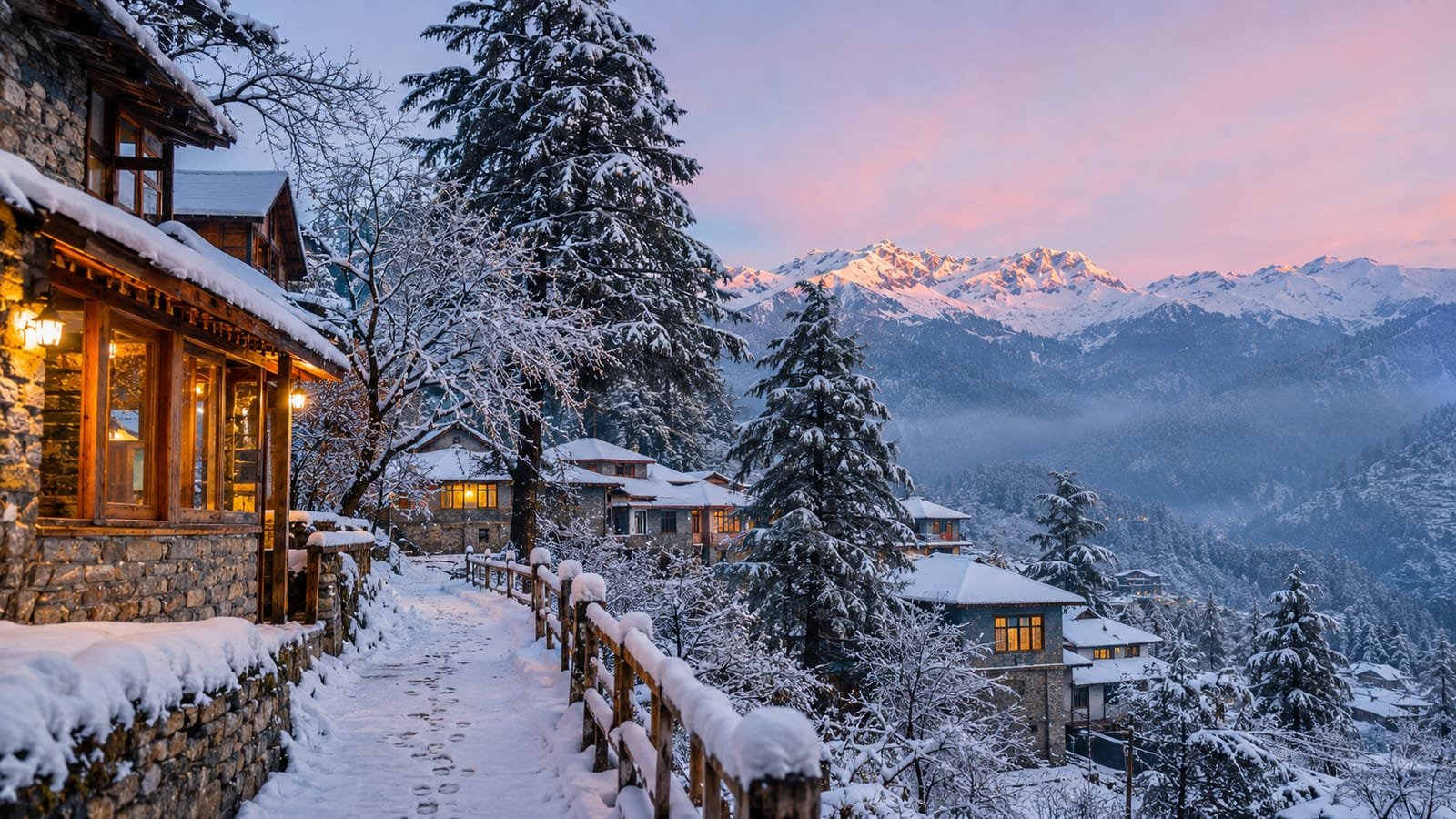
Winter and snow
December to early MarchHighs of 10 to 17 C and lows from -1 to 3 C. Snow falls in town mainly from December to early March. January is the coldest month.
How busy it gets (100 = busiest month)
Dec100
Jan84
Feb59
Mar62
Himachal Pradesh · Manali
For mild weather, go April to June or September to October. For snow in town, go December to early March. July and August are the wettest months, with 202 and 217 mm of rain, and hotels cost least then. Late December and May to June are the busiest.
Things that can change a trip right now. Always check the official source before you travel.
Average highest and lowest temperature, rainfall, and how hotel prices move against an average month.
High 11°Low -1°
Hotels -10%
High 12°Low 0°
Hotels -20%
High 17°Low 3°
Hotels -15%
High 21°Low 6°
Hotels +10%
High 25°Low 9°
Hotels +30%
High 26°Low 13°
Hotels +30%
High 26°Low 16°
Hotels -20%
High 25°Low 16°
Hotels -25%
High 24°Low 12°
Hotels -15%
High 22°Low 6°
Hotels near average
High 17°Low 3°
Hotels -10%
High 14°Low 0°
Hotels +30%
Temperature and rain are India Meteorological Department averages for 1991 to 2020 at the Manali observatory (2,039 m). Rain includes snow in winter. Hotel price changes are our own estimate, not a published tariff. We based them on three things: HPTDC's winter discounts of 20 to 40 percent from January to April, one private hotel's peak dates (a peak room costs about 1.5 times the regular rate), and how busy Manali gets, which is highest in December and in May and June. Snow in town falls mainly from December to early March.
Temperatures and rain are India Meteorological Department 1991 to 2020 averages for the Manali observatory.
Highs of 10 to 17 C and lows from -1 to 3 C. Snow falls in town mainly from December to early March. January is the coldest month.
Highs rise from 17 to 25 C. March is the wettest of the three at 155 mm, including melting snow. May is the driest, at 66 mm.
The warmest month, with an average high of 26.4 C and low of 13.0 C. Rainfall is 90 mm, and the monsoon starts to build.
Highs of 25 to 26 C and lows of 16 C. The wettest months at 202 and 217 mm.
Highs fall from 24 to 17 C. October is the driest month at 25 mm. First snow reaches the high passes from October and November.
The busy score is a rough guide to crowds. It uses how much people search for Manali each month in India over five years (Google Trends), scaled so the busiest month is 100. It is not a visitor count.
Rohtang Pass is normally open from about May to November and closed by snow the rest of the year. As of 23 Nov 2026 it is closed to tourist vehicles, and no reopening date had been announced. Opening dates change from year to year with snow clearance.
The Atal Tunnel bypasses the pass and keeps the Manali to Lahaul road usable through winter, though it can close briefly after heavy snow. See the permits and rules guide for fees and quotas.
It depends on the trip. For mild weather, April to June and September to October. For snow in town, December to early March. October is the driest month at 25 mm of rain.
Snow in Manali town falls mainly from December to early March. Higher places such as Solang, the Atal Tunnel and Rohtang get snow earlier and later: the high passes saw fresh snow on 13 Nov 2026.
January is the coldest month, with an average high of 10.5 C and an average low of -1.1 C at the IMD observatory. The lowest temperature on record there is -11.6 C, in January 1998.
July and August bring 202 and 217 mm of rain, the most of the year. Hotels cost least, but weather can disrupt plans, and rafting and paragliding are reported to be banned from 15 July to 15 September. Check current rules before you go.
Late December and May to June. Interest in Manali peaks in December and in May and June (see the busy scores above), and by our estimate hotel prices run about 30 percent above an average month then.
November is a quiet month. IMD averages are a high of 17.3 C and a low of 2.6 C, with 31 mm of rain. The high passes get snow, and Rohtang was closed to tourist vehicles on 13 Nov 2026.
Where every number on this page comes from.
Change log. 23 Nov 2026: First published. Climate from IMD 1991 to 2020 normals; demand from Google Trends.